

If you spend any time in the skincare aisle at CVS or scrolling Amazon reviews, you have probably landed on both of these. CeraVe Eye Repair Cream and Olay Eyes Pro-Retinol Eye Treatment sit in the same general price range, both carry thousands of reviews, and both claim to fix the same basic complaints: puffiness, dark circles, and crepey under-eye skin. So which one should you actually use? The short answer is that it depends entirely on what your under-eye area actually needs. I have tested both for an extended period and the differences are real.
CeraVe is a barrier-repair cream built around hyaluronic acid, niacinamide, and ceramides. Olay Pro-Retinol is a retinoid treatment in eye-cream form. Those are different tools for different jobs. This comparison breaks down where each one wins, where each one falls short, and which skin type each is genuinely suited for.
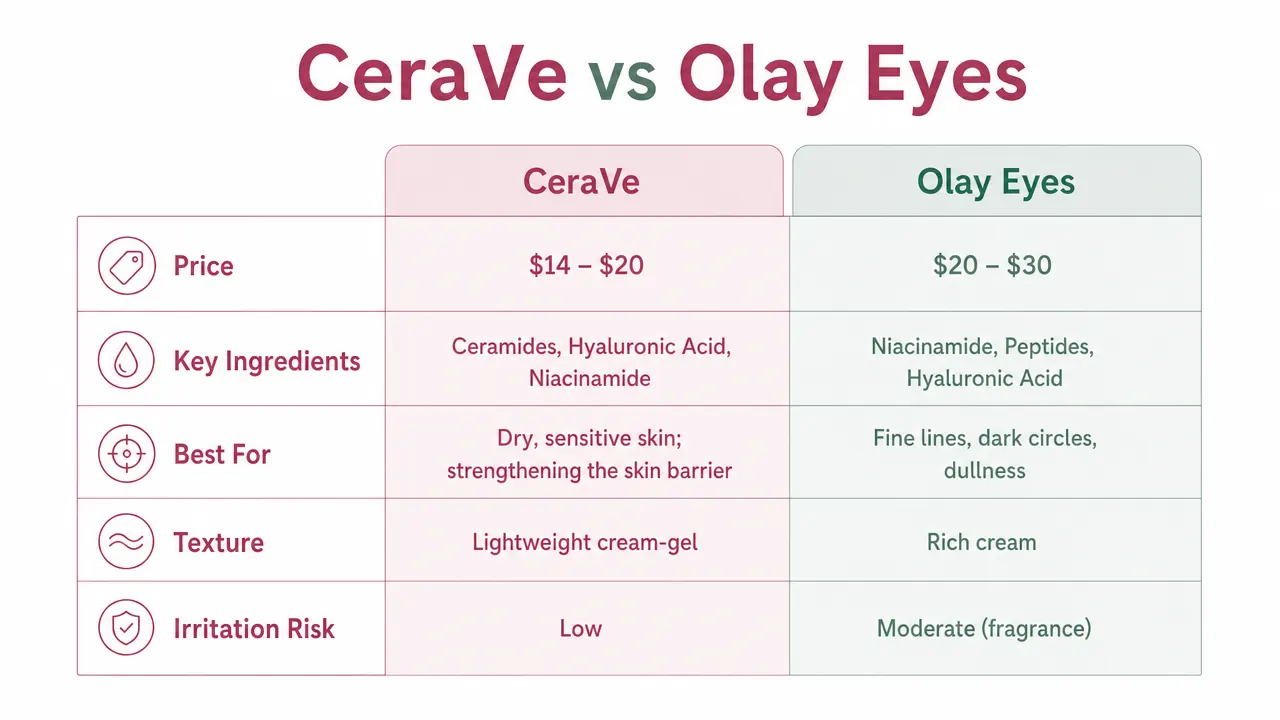
| attribute | left | right | winner |
| attribute | left | right | winner |
| attribute | left | right | winner |
| attribute | left | right | winner |
| attribute | left | right | winner |
| attribute | left | right | winner |
| attribute | left | right | winner |
| attribute | left | right | winner |
| attribute | left | right | winner |
| attribute | left | right | winner |
Puffiness and dryness under your eyes? CeraVe is the lower-risk starting point.
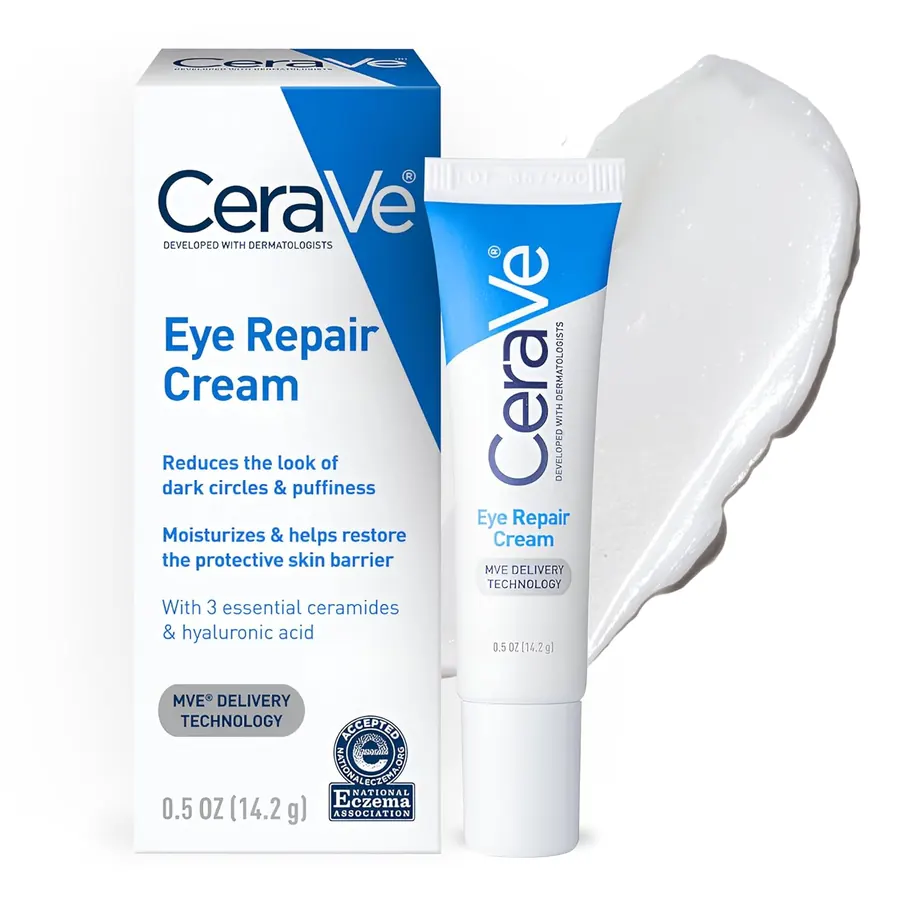
CeraVe Eye Repair Cream works with your skin barrier, not against it. Fragrance-free, ophthalmologist-tested, and under $15. It is the one I reach for in the morning when my eyes are swollen from a poor night's sleep.
Amazon Check Today's Price on Amazon →The Ingredient Story: Why These Two Products Are Not Really Competing
CeraVe Eye Repair Cream leads with ceramides 1, 3, and 6-II, hyaluronic acid, and niacinamide. Ceramides are lipids naturally found in your skin barrier. When the skin around your eyes gets dry, thin, or irritated, the ceramide ratio drops and moisture escapes faster. Topping that back up with a ceramide-heavy cream reduces transepidermal water loss and keeps the tissue plumper and more resilient. The hyaluronic acid adds immediate surface hydration. The niacinamide helps with pigment regulation over time. There is also a small amount of peptide complex in the formula, which supports collagen structure around the eye socket.
Olay Eyes Pro-Retinol uses retinyl propionate as its active. This is a gentler ester form of retinol rather than straight retinaldehyde or tretinoin, which is why Olay markets it as appropriate for the delicate eye area. Retinoids, even mild ones, accelerate cell turnover. Over 8 to 12 weeks, that process genuinely resurfaces the top layer of skin, reduces fine lines from repeated squinting, and can lighten some surface-level discoloration. However, retinoids do not hydrate the same way ceramides do. If your primary complaint is morning puffiness or a feeling of dryness and tightness, a retinoid is not your best first tool.
The formulas are simply targeting different problems. If you try to use Olay for puffiness relief and CeraVe for fine-line correction, you will be disappointed with both. Knowing what your under-eye area actually needs is the whole game here. For practical guidance on building a morning routine around an eye cream, the guide on how to reduce puffy eyes with an eye cream walks through layering order and application technique in detail.
Where CeraVe Wins
CeraVe is the better pick for three specific situations: when your under-eye skin is noticeably dry and flaky, when puffiness is your number-one complaint, and when you have sensitive or reactive skin that does not tolerate fragrance or active ingredients well. The ceramide-forward formula is also suited to people who have overdone retinol on the rest of their face and need an eye area that will not react.
In practical terms, CeraVe absorbs in about 30 to 45 seconds and leaves a slight softness under the eye that makes concealer sit more smoothly. I noticed a visible reduction in morning puffiness after about three weeks of consistent use, applied twice daily with gentle tapping motions. It does not sting, does not migrate into the eyes, and does not pill under makeup. For those with eczema-prone or very dry skin around the eye socket, this is one of the few eye creams that has a genuinely reassuring ingredient list. It is also the least expensive option of the two by about $10 at most price points.
CeraVe does not promise dramatic wrinkle reduction. What it does well is keep the under-eye area hydrated, calm, and less puffy over time. That is a real, useful result.
Where Olay Eyes Pro-Retinol Wins
If fine lines and crepey texture around the outer corners of the eyes are your main concern, Olay's retinyl propionate has a credible case. Retinoids are the most clinically supported ingredient class for skin-cell turnover and visible wrinkle reduction. Even the gentler ester version in Olay does drive meaningful change in skin texture over a 10-to-12-week period. That is not a claim CeraVe can match.
The Olay formula also has a lighter texture, which some people prefer under a concealer or eye makeup because it does not leave any heaviness or shine. It absorbs almost instantly. For someone in their 40s or older who has already established a solid moisturizing routine and wants to add a low-dose retinoid to the eye area without risking the irritation of a full-face retinol product, Olay Pro-Retinol is a sensible option. The key is patience: three weeks will tell you nothing. Give it 12 weeks minimum before evaluating the texture improvement.
The Dark Circle Question
Both products mention dark circles on their packaging or in marketing language. Both can help slightly. Neither will make a dramatic difference if your dark circles are structural, meaning caused by the orbital bone, thin skin, or visible blood vessels below the surface. That is a physical reality, not a formula problem. No drugstore eye cream, regardless of price point, resolves structural dark circles. What they can do is reduce surface discoloration from hyperpigmentation. CeraVe's niacinamide targets melanin transfer at the skin-cell level. Olay's retinoid accelerates turnover of pigmented cells. Both pathways can produce modest improvement over 8 to 12 weeks. Expect subtle, not dramatic.
If dark circles are your primary concern, you will get more mileage from adding a vitamin C serum to your morning routine than from upgrading eye creams. The under-eye results from a consistent brightening serum paired with either of these creams tend to outperform either product alone. I cover that in detail in the long-term CeraVe Eye Repair Cream review, which also addresses dark circles specifically after four months of twice-daily use.
Texture and Application Differences
These two feel noticeably different on the skin. CeraVe is a thick balm. You use a small amount, about the size of a grain of rice per eye, and tap it in with your ring finger (the finger with the lightest natural pressure). It goes on white and settles to a soft, slightly dewy finish. If you apply too much or rub rather than tap, it will ball up under makeup. The trick is less product than you think and a tapping motion.
Olay Pro-Retinol is a lighter lotion. It blends in almost immediately with no visible residue. This makes it more forgiving for people who move quickly through their morning routine and do not want to wait for a thick cream to absorb. On the flip side, the lightness means it provides less occlusive protection overnight, which is why I use it at night only when my skin is already well-moisturized from the rest of my routine.

Irritation and Sensitivity: An Honest Assessment
CeraVe Eye Repair Cream is fragrance-free and ophthalmologist-tested. The ingredient list has no known common irritants. I have not experienced any redness, stinging, or increased sensitivity from it, and most reviewers with sensitive or rosacea-prone skin report the same. It is one of the safer eye creams you can reach for if your skin tends to react.
Olay Eyes Pro-Retinol requires a slower introduction. The retinyl propionate in the formula is gentler than retinaldehyde or tretinoin, but it is still a retinoid. If you apply it nightly from day one, you may get mild flaking or sensitivity around the eye area in weeks two through four. The recommended approach is to start three nights per week, watch how your skin responds, and build to nightly use over four to six weeks. This is not a reason to avoid Olay Pro-Retinol, but it is a reason to plan for the adjustment period rather than being surprised by it.
Who Should Buy Which
Buy CeraVe Eye Repair Cream if: puffiness and morning swelling are your first complaint; your under-eye skin feels dry or tight; you have sensitive or reactive skin that does not tolerate active ingredients; you want to spend less; or you need something that layers reliably under makeup without balling up. It is also the right call if you are new to eye creams and want to start with something low-risk and broadly compatible with any routine.
Buy Olay Eyes Pro-Retinol if: fine lines, crow's feet, and crepey texture are your primary concern; you already have a good moisturizing routine in place; you are comfortable with a 12-week commitment before evaluating results; and your skin does not have a history of retinoid sensitivity. It is a good choice for someone in their late 30s to 50s who wants to add a mild retinoid around the eyes without reaching for prescription retinoids.
Some people use both: CeraVe in the morning for hydration and makeup prep, and Olay at night for the retinoid benefit. That is a reasonable strategy if you want to address both puffiness and texture at the same time without stacking too many actives into one product.
Starting with eye cream? CeraVe is the lower-risk, lower-cost entry point that works for almost every skin type.
CeraVe Eye Repair Cream has over 73,000 Amazon ratings and costs under $15. It is a fragrance-free, ophthalmologist-tested formula that addresses puffiness and dryness without any adjustment period. A solid first step.
Amazon Check Today's Price on Amazon →