

I spent years applying the same face moisturizer under my eyes and wondering why the puffiness and shadows never budged. The answer turned out to be simpler than I expected: the skin beneath your eyes operates by different rules than the rest of your face. It is thinner, more prone to fluid retention, and almost entirely without oil glands. A moisturizer built for your forehead or cheeks was not formulated with any of that in mind. A dedicated eye cream is. Below are ten specific reasons that distinction matters, illustrated by what I have seen using CeraVe Eye Repair Cream over four months of twice-daily use.
If you want the full breakdown of how this cream performed over time, I covered that in my long-term CeraVe Eye Repair Cream review. This piece focuses on the category itself: why an eye cream is a different product doing a different job, and why that matters for puffiness, pigmentation, and the overall look of your eye area.
Still using your regular face moisturizer under your eyes? This is why it is not working.
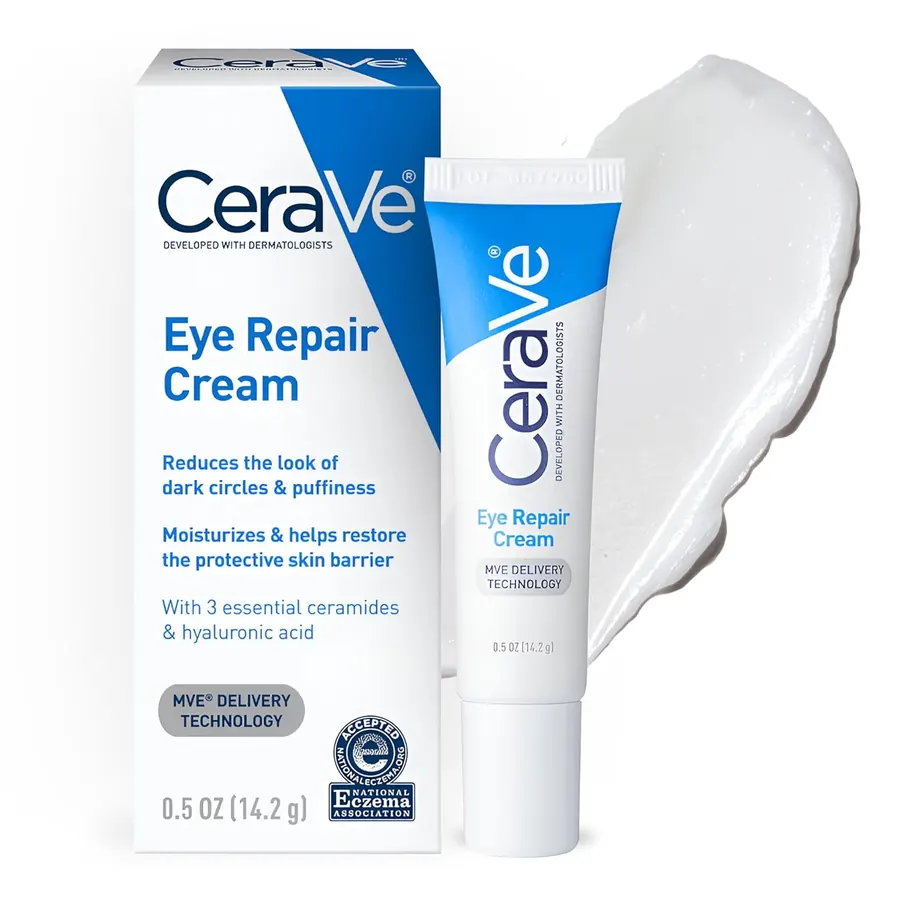
CeraVe Eye Repair Cream is formulated specifically for the delicate under-eye area. Hyaluronic acid, niacinamide, and ceramides in a fragrance-free, ophthalmologist-tested formula. Over 73,000 Amazon reviews and still one of the best-value options in the category.
Amazon Check Today's Price on Amazon →The Skin Under Your Eyes Is Three Times Thinner Than the Rest of Your Face
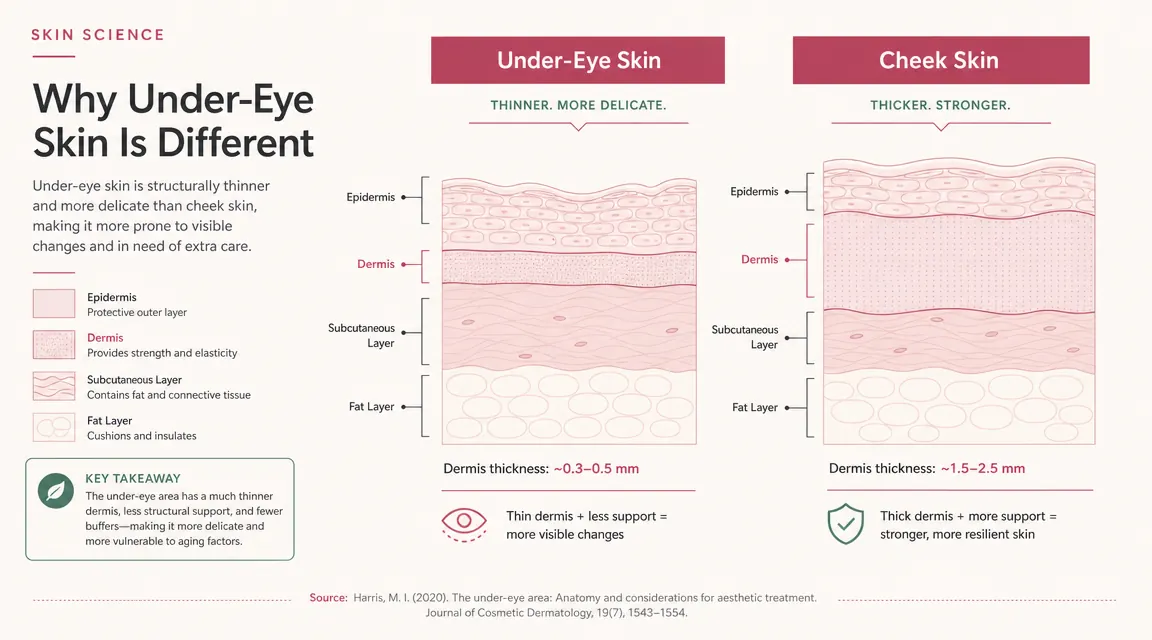
The periorbital skin (the skin surrounding your eye socket) averages about 0.5mm thick, compared to roughly 1.5mm on the cheeks or forehead. That thinness means everything underneath, including blood vessels, pigment, and fluid, shows through far more easily. An eye cream targets that transparency directly with ingredients sized and concentrated for thin tissue. A regular moisturizer is simply not calibrated for it. This is the foundational reason every other item on this list exists.
Dedicated Formulas Deliver Hyaluronic Acid at the Right Depth for Under-Eye Plumping
Hyaluronic acid (HA) works by drawing moisture into the skin's outer layers, which temporarily plumps the tissue and reduces the sunken look that makes under-eye bags appear more prominent. CeraVe Eye Repair Cream includes HA in a concentration and molecular size appropriate for periorbital skin. Applying a thick general moisturizer loaded with occlusives instead can sit on top of the skin without the same plumping effect in such a thin area.
Niacinamide in an Eye Cream Addresses the Pigmentation Under Your Eyes, Not Just the Surface
Dark circles caused by pigmentation (as opposed to vascular circles from visible blood vessels) respond to niacinamide, which inhibits the transfer of melanin to skin cells. CeraVe Eye Repair Cream includes niacinamide as one of its active ingredients, which is why it is listed as a treatment for both bags and dark circles. A standard moisturizer rarely includes niacinamide at a meaningful concentration, and if it does, it was not formulated with the under-eye application zone in mind.
Eye Creams Are Tested for Ophthalmologist Safety, Regular Moisturizers Are Not
Products applied close to the eyes carry a different safety burden. Migration into the eye is a real risk with any emollient, and ingredients that are fine on cheekbones can cause irritation, redness, or blurred vision if they get into the eye. CeraVe Eye Repair Cream is ophthalmologist-tested, which means it went through safety review for periorbital use. Most general moisturizers do not carry that designation because they were never tested with eye-proximity as a criterion.
The under-eye area does not have oil glands the way the rest of your face does. It relies almost entirely on what you apply topically. That is why skipping an eye cream here is different from skipping one on your cheeks.
Ceramides in an Eye Cream Reinforce a Barrier That Loses Moisture Faster Than Anywhere Else
Because the periorbital area lacks oil glands, its natural barrier is weaker than the surrounding skin. Without consistent barrier support, moisture evaporates quickly (transepidermal water loss, or TEWL), leaving the tissue looking crepe-textured and highlighting fine lines. Ceramides are the backbone of skin barrier function. CeraVe Eye Repair Cream includes three essential ceramides (CER AP, CER EOP, CER NP) in a formula designed to stay in place on delicate skin rather than slip off.
The Texture Is Calibrated to Stay Put Without Creasing Into Fine Lines
Heavy face moisturizers and rich creams can migrate up into the orbital area during the day, causing makeup to crease and potentially irritating the waterline. Eye creams are formulated with textures (usually lightweight gels or thin cream-gels) that absorb quickly and stay where they are applied. CeraVe Eye Repair Cream sits in that category: light enough to wear under concealer without pilling, substantive enough to feel like it is actually doing something.
Consistent Application Reduces Morning Puffiness by Supporting Lymphatic Drainage
Morning under-eye puffiness is mostly fluid that accumulated overnight as you lay flat and gravity stopped pulling it away from your face. Gentle tapping application of an eye cream encourages the lymphatic vessels in the periorbital area to move that fluid toward the temples and down toward the lymph nodes in the neck. The cream itself helps, but the application method matters too. Most eye cream packaging (small jars, narrow tubes) implicitly encourages the careful ring-finger tapping that regular moisturizer, applied palm-to-face, does not.

Fragrance-Free Formulas Prevent the Reactive Redness That Makes Under-Eye Circles Look Worse
Fragrance is one of the most common skin sensitizers, and even people who tolerate it well on their cheeks may experience redness or swelling near the eye where the skin is thinner and more reactive. CeraVe Eye Repair Cream is fragrance-free, which removes that sensitization risk entirely. Many general moisturizers add fragrance for the sensory experience, which is fine on the face but genuinely counterproductive applied close to the eyes.
A Dedicated Eye Cream Gives You a Clear Twice-Daily Habit Around the Eye Area
One underrated reason eye creams help: they create an intentional step in your routine focused on the under-eye area rather than treating it as an afterthought of general moisturizing. Twice-daily application, morning and night, adds up to consistent barrier support and ingredient delivery that occasional or haphazard use of a face cream cannot match. Results from CeraVe Eye Repair Cream, like most skincare, are cumulative. Four weeks of consistent use looks different from two weeks.
The Cost-Per-Use Makes Eye Creams One of the Most Efficient Products in Your Routine
A pea-sized amount, split between both under-eye areas, is all you need per application. At that rate, CeraVe Eye Repair Cream at its current price lasts well over two months for twice-daily use, which works out to well under a dollar a day. Compare that to the price of a concealer you buy to cover dark circles that a good eye cream could reduce over time. The ROI on a consistent eye cream habit is genuinely high, especially at this price tier.
What I Would Skip
I would skip any eye cream that leads with fragrance, essential oils, or a lengthy proprietary blend where you cannot identify what the active ingredients actually are. I would also skip very thick, petroleum-heavy formulas for daytime use under the eyes. They tend to migrate into the eyes within a few hours, irritate the waterline, and make concealer application nearly impossible. For comparison context on how CeraVe stacks up against a retinol-based option, my CeraVe vs Olay Eyes Pro-Retinol comparison covers exactly that question.
I would not skip an eye cream in favor of just using more of whatever is already on my face. The area needs its own product, used consistently, and with the right technique. That combination is what actually moves the needle on puffiness and pigmentation over time.
Four months of twice-daily use. Still the eye cream I reach for first.
CeraVe Eye Repair Cream delivers hyaluronic acid, niacinamide, and three ceramides in a fragrance-free, ophthalmologist-tested formula that works for sensitive and reactive skin types. It is not a dramatic overnight fix, but used consistently, it makes a visible difference in puffiness, pigmentation, and under-eye skin texture.
Amazon Check Today's Price on Amazon →