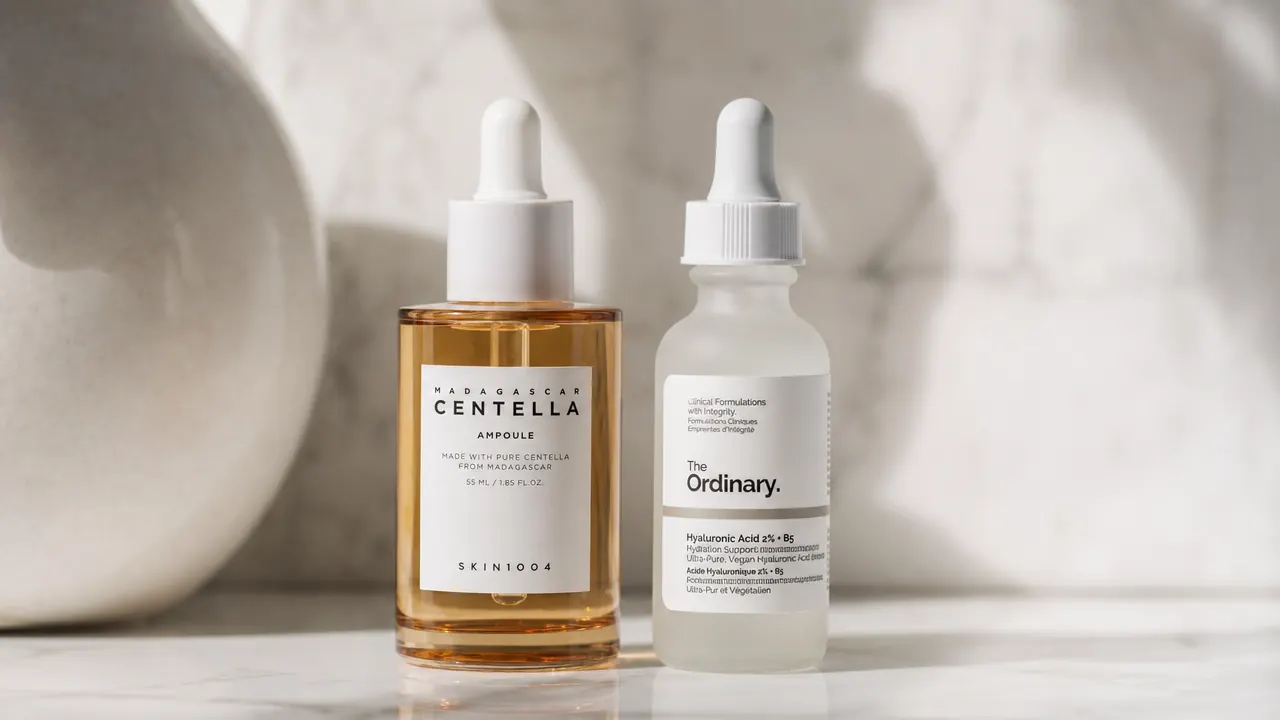
If you have spent any time reading about oily skin and visible pores, you have probably come across two names more than any others: The Ordinary Niacinamide 10% + Zinc 1%, which costs about $6 for a 30ml bottle, and Paula's Choice Skin Perfecting 2% BHA Liquid Exfoliant, which runs around $35 for a similar size. Both have devoted followings. Both get credited with the same outcomes: smaller-looking pores, less oil, clearer skin. So the obvious question is whether one is genuinely better, or whether they are just two routes to the same destination.
The short answer is that these products do not compete with each other the way people assume. They work through different mechanisms, suit different skin concerns, and fit different routines. Choosing between them should not come down to price alone. It should come down to what your skin actually needs. I have tested both over a combined period of roughly eight months on combination-oily skin, and the conclusions I landed on surprised me.
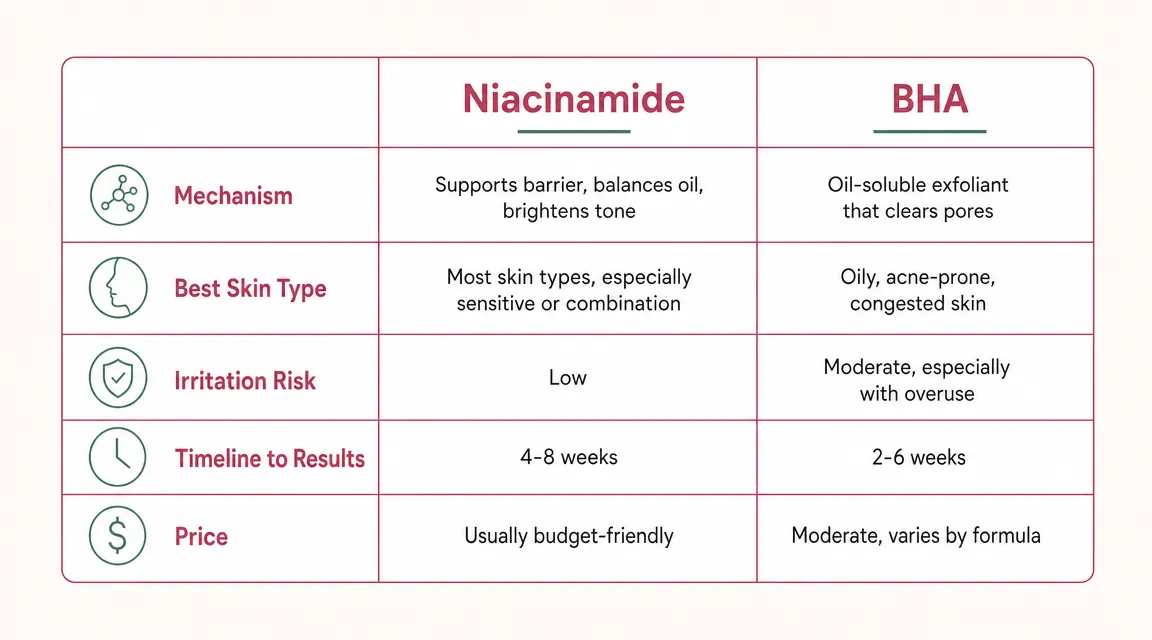
| label | left | right |
| label | left | right |
| label | left | right |
| label | left | right |
| label | left | right |
| label | left | right |
| label | left | right |
| label | left | right |
| label | left | right |
| label | left | right |
If pore-clogging and oiliness are your main issues, The Ordinary Niacinamide is the lower-risk starting point.
At $6 a bottle with over 56,000 ratings and a 4.7-star average, it is one of the most stress-tested serums available at any price point. You can use it daily without building up tolerance or worrying about barrier disruption.
Amazon Check Today's Price on Amazon →What These Two Products Actually Do
Niacinamide is a form of vitamin B3. It does not exfoliate. It does not unclog pores from the inside. What it does is regulate sebum production at the level of the sebaceous gland, reinforce the skin barrier, reduce transepidermal water loss, and calm redness over time. The result, with consistent use, is skin that produces less oil, looks less congested on the surface, and has a smoother, more even appearance. The Ordinary version is formulated at 10%, which is the concentration used in most of the clinical studies. It also includes 1% zinc PCA, which adds an additional sebum-regulating and mild anti-inflammatory layer.
Paula's Choice 2% BHA is a salicylic acid product. Salicylic acid is oil-soluble, which means it can penetrate through the lipid layer inside a pore and dissolve the mixture of dead skin cells and sebum that causes blackheads and comedones. It is a genuine exfoliant. It removes material that is physically blocking the follicle. That is a different mechanism entirely, and it explains why the BHA often works faster on visible blackheads while the niacinamide works more broadly on oil control and surface clarity.
Understanding this distinction is what makes the comparison meaningful. People who call them interchangeable are usually thinking only about the end outcome, which is cleaner-looking pores. They are not thinking about the pathway, which is where the two products diverge completely. One is a regulator. The other is a cleaner. Whether you need a regulator or a cleaner depends on the specific way your pores are causing you trouble.
Where The Ordinary Niacinamide Wins
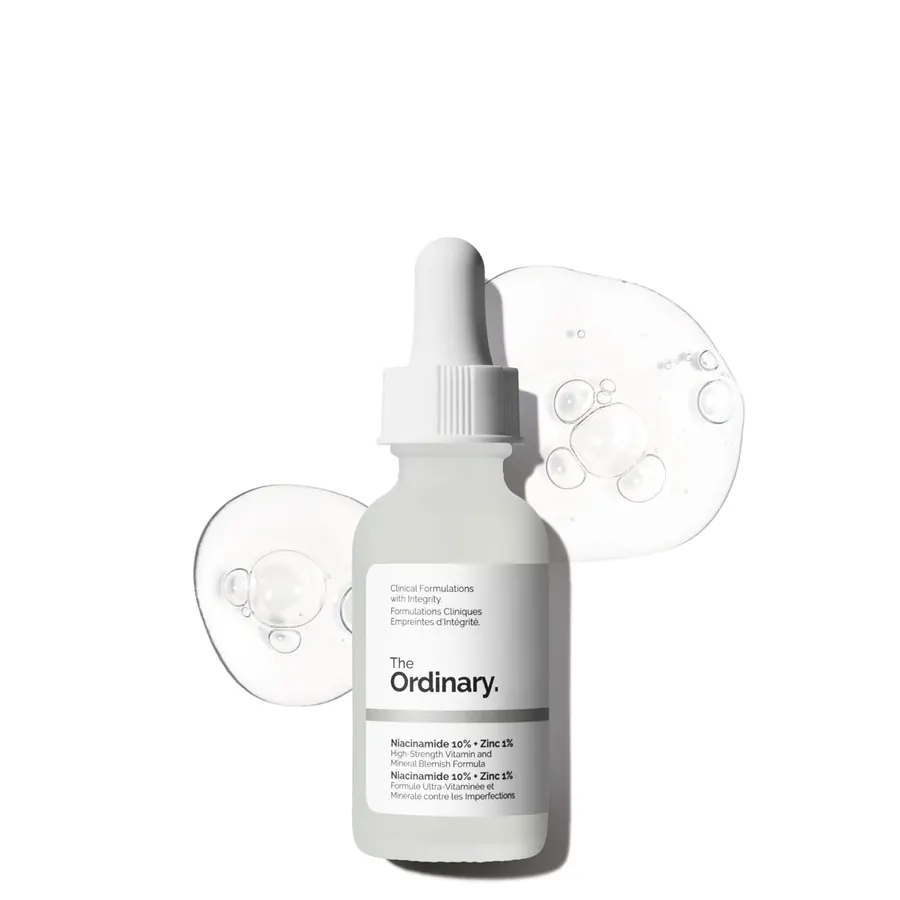
The biggest practical advantage of The Ordinary Niacinamide is that almost anyone can use it daily without issue. There is no adjustment period, no irritation window, no need to introduce it slowly. You apply it after cleansing, before moisturizer, morning or evening or both. That simplicity matters a lot if your routine is already busy or if your skin is on the sensitive side. I have used it twice daily for three months without a single flare-up, and my skin type runs combination-oily with occasional hormonal breakouts.
It is also the better choice if your primary concern is midday oil shine rather than deep-pore congestion. Within two to three weeks of daily use, I noticed a real reduction in how oily my forehead looked by noon. Not matte, but noticeably less slick. By week six, the orange-peel texture on my nose had softened visibly. If you have not yet read the full long-term write-up, the three-month niacinamide review covers those changes in more detail, including side-by-side notes from weeks two, six, and twelve.
The price point also cannot be dismissed entirely. At $6 a bottle, you can use it generously and replace it without hesitation. That accessibility means more consistent use, and consistency is the variable that matters most with any topical ingredient. A product you use every single day will outperform a product you ration or skip because you are trying to make the bottle last.
Where Paula's Choice BHA Wins
If your main complaint is blackheads on your nose and chin, or closed comedones across your forehead, the BHA is going to address that more directly. Niacinamide will reduce future sebum production, but it does not dissolve the material that is already sitting inside an existing clogged pore. Salicylic acid does. That distinction is the whole ballgame for some skin types.
Paula's Choice is also formulated at a carefully buffered pH that keeps the salicylic acid effective without being unnecessarily harsh. The liquid delivery system, applied with a cotton pad, makes it easy to work across the entire face without missing spots. Most users with blackhead-heavy skin notice visible clearing within two to three weeks, which is faster than the niacinamide timeline for that particular concern.
The one caveat is that BHA exfoliants do require a slow introduction if your skin is not accustomed to chemical exfoliation. Starting at two to three times per week and building up is the standard guidance. Jumping straight to daily use sometimes leads to dryness, flaking, or a compromised barrier, especially in drier or more reactive skin types. If you do experience tightness or peeling, dial back frequency rather than stopping entirely. The goal is to find the highest frequency your skin tolerates consistently.
Niacinamide manages the oil. BHA clears the blockage. Picking between them depends on whether your problem is production or congestion.
Can You Use Both at the Same Time?
Yes, and this is actually the approach many people with oily, congested skin land on after trying each one separately. The combination works well because the two products address different parts of the pore problem. The BHA clears existing congestion. The niacinamide reduces the rate at which congestion rebuilds. Used together, they complement rather than duplicate each other.
The layering order matters. Apply the BHA first on clean skin, let it absorb for several minutes, then apply the niacinamide serum. Some people apply the BHA at night only and the niacinamide morning and night. That approach keeps the exfoliant in controlled contact while letting the niacinamide work on barrier support and oil regulation throughout the day. If you are interested in building out a full pore-minimizing routine, the step-by-step guide to minimizing pores with a niacinamide serum covers routine sequencing and ingredient pairing in detail.
The one combination to watch for is applying a BHA directly on top of a niacinamide product that has not fully absorbed. There is a historical concern that niacinamide and certain acids interact to form niacin, which can cause temporary flushing. In practice, this effect is rare and mild at the concentrations used in most over-the-counter serums. Waiting a few minutes between applications eliminates it as a variable entirely.
Who Should Buy Which
Buy The Ordinary Niacinamide if you have oily or combination skin and your main concerns are shine, surface congestion, or mild blemishes. Buy it if you want a daily-use serum that fits neatly into any routine without adjustment periods. Buy it if you are new to serums and want to see what addressing sebum regulation feels like before adding an exfoliant. It is also the right first step if your skin is sensitive-oily: the BHA may be too stimulating as a starting point, and the niacinamide will give you useful information about how your skin responds to a targeted active ingredient.
Buy Paula's Choice 2% BHA if blackheads and clogged pores are the dominant complaint. If you look closely at your nose or chin and see visible plugs, not just large pores, but actual dark-tipped blockages, a BHA will address that more effectively than niacinamide alone. Buy it if you already have a stable routine and are ready to add a chemical exfoliant. Buy it if you have used BHAs before and know your skin tolerates them.
If you are not sure which category you fall into, start with the niacinamide. It covers more ground, carries a lower ceiling on potential irritation, and costs almost nothing to try. If after eight weeks you still have persistent blackheads or rough texture that is not responding, that is the right time to add a BHA alongside it.
For most people with oily or combination skin, the niacinamide is the lower-risk first step.
The Ordinary Niacinamide 10% + Zinc 1% has over 56,000 Amazon reviews and a 4.7-star average. At current pricing it is one of the best-value serums available. Check today's price to see if it is in stock.
Amazon Check Today's Price on Amazon →